
How to Grow a Small Business Online: A Practical Digital Growth Guide
Growing a small business online requires more than creating a website or posting regularly on social media. You need a clear strategy that helps the right people discover your business, understand your value, trust your services, and become paying customers. For many small business owners, the challenge is knowing where to start. Should you invest in search engine optimization (SEO), social media marketing, website development, or content creation? Without a plan, it is easy to spend time on activities that generate attention but few inquiries or sales.
This practical guide explains how to grow a small business online using affordable, measurable, and sustainable methods. You will learn how to identify your ideal customers, improve your website, attract organic traffic, create useful content, build credibility, and convert visitors into clients. Whether you are launching a startup or trying to expand an established business, these online business growth strategies can help you prioritize your efforts and make better marketing decisions.

How Can You Grow a Small Business Online?
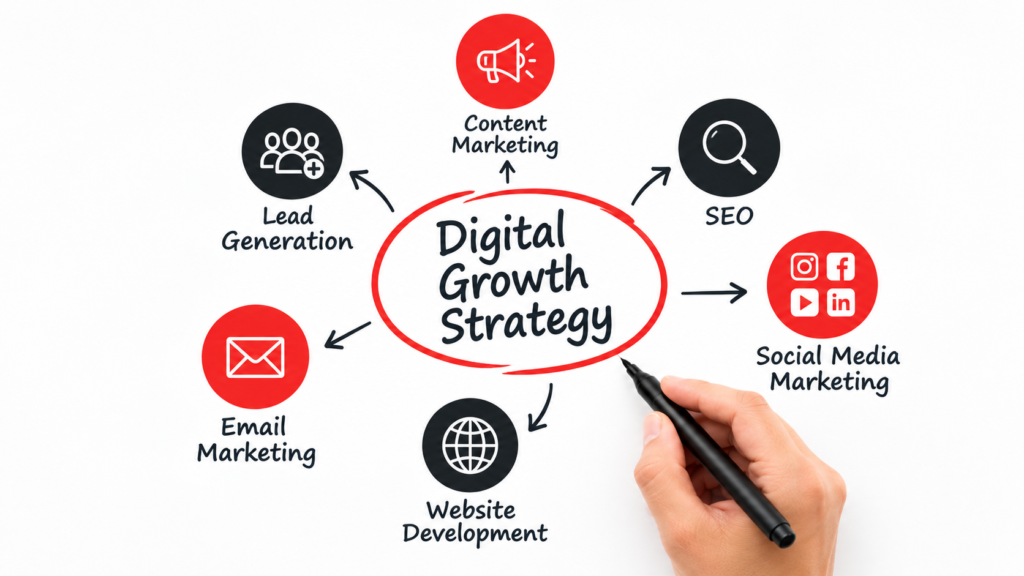
You can grow a small business online by defining your target audience, building a conversion-focused website, improving your search visibility, publishing valuable content, maintaining relevant social media channels, and following up with potential customers. Start with the activities most closely connected to your customers’ needs and your business goals. Measure website inquiries, qualified leads, conversion rates, and revenue rather than focusing only on likes or followers. You do not need to use every digital marketing channel immediately; consistency, relevance, and continuous improvement are more important than doing everything at once.
1. Define Your Target Audience and Business Goals
Before investing time in marketing, identify exactly whom you want to reach and what you want to achieve. A business that tries to serve everyone often struggles to communicate why customers should choose it. A more focused approach makes your website, messaging, and marketing activities more relevant.
Identify your ideal customer
Create a simple customer profile that includes:
-
Industry: Which industries benefit most from your product or service?
-
Location: Are you targeting local customers, national buyers, or international markets?
-
Business size: Are your ideal clients startups, small businesses, or established companies?
-
Main challenges: What problems do they need help solving?
-
Buying behavior: Where do they search for solutions, and what influences their decisions?
For example, a web development agency targeting international small businesses might focus on companies with outdated websites, unclear service pages, or weak inquiry processes. This positioning makes it easier to develop relevant service pages, articles, and offers.
Set measurable goals
Choose goals that connect marketing activity to business outcomes. Examples include increasing qualified website inquiries, improving organic search traffic, generating more consultation requests, or converting more existing leads into customers. Establish your current performance as a baseline, then review progress monthly. Your targets should reflect your available time, market, budget, and starting position rather than arbitrary growth promises.
2. Build a Website That Converts Visitors into Customers
Your website should function as your digital business headquarters. Social media can introduce people to your brand, but your website should help them understand your services and take the next step.
Improve the essential website elements
Start with these priorities:
Clear headline: Explain what you do, whom you help, and the value you provide.
Specific service pages: Give each major service its own page with descriptions, benefits, deliverables, and relevant examples.
Visible calls to action: Use clear options such as “Request a Quote,” “Book a Consultation,” or “Discuss Your Project.”
Trust signals: Display genuine testimonials, relevant experience, client-approved case studies, and an accessible business contact section.
Mobile usability: Ensure visitors can read your content, navigate your pages, and complete forms on mobile devices.
Simple inquiry forms: Ask for the information needed to qualify a lead without making the form unnecessarily long.
For example, a business owner searching for website redesign services should quickly understand your process, what is included, and how to request a proposal.
Review loading speed, accessibility, broken links, and technical issues as well. Google’s SEO guide for developers explains important steps for making websites easier to discover and understand.
Practical action: Visit your website as if you were a first-time customer. Can you understand the offer within a few seconds and identify how to contact the business? If not, improve that experience before adding more marketing activities.
3. Use SEO to Attract Customers Who Are Already Searching
Search engine optimization helps potential customers discover your business when they search for relevant products, services, and solutions. Unlike social media content that may receive attention briefly, useful search-focused content can continue attracting visitors over time. However, organic visibility takes work and is never guaranteed.
Start with keyword research
Identify three types of search terms:
Service keywords: “small business website development services”
Problem-based keywords: “how to improve website conversions”
Informational keywords: “how to grow a small business online”
Use tools such as Google Search Console, Google Trends, and Google Keyword Planner to investigate search queries, trends, and potential keyword opportunities. Available data and features vary by tool.
Map each primary keyword to the most appropriate page. A service keyword usually belongs on a service page, while an educational question may be better suited to a blog article.
Optimize pages naturally
For each important page:
Write a descriptive SEO title and meta description.
Use a clear H1 heading and logical H2 and H3 subheadings.
Include relevant terms naturally in the content.
Add descriptive alt text to meaningful images.
Link to related services and useful articles.
Ensure search engines can crawl and index the page.
Avoid repeating the same keyword excessively. Google’s SEO Starter Guide emphasizes creating useful, understandable content rather than relying on shortcuts.
Practical action: Begin with your five most commercially important pages. Improve their content, technical accessibility, internal links, and calls to action before trying to optimize your entire website at once.
4. Publish Helpful Content That Builds Authority
Content marketing allows a business to demonstrate expertise before asking a potential customer to buy. A well-planned blog can answer common questions, address customer concerns, explain services, and support your SEO strategy.
Develop a content plan around customer problems
Choose topics that connect directly to your services and target audience.
For a digital agency, suitable topics might include:
How to choose a website development company.
SEO mistakes that prevent small businesses from attracting customers.
Website redesign checklist for growing businesses.
Social media marketing strategies for startups.
How to evaluate digital marketing performance.
Each article should answer a specific question and provide practical steps, examples, and relevant sources.
Use a repeatable publishing process
For every article:
Research the intended audience and search intent.
Select one primary keyword and related supporting topics.
Create a useful outline.
Write original explanations and practical recommendations.
Add relevant internal and authoritative external links.
Include a suitable call to action.
Review accuracy, readability, and performance after publishing.
AI tools can help with brainstorming, outlining, and editing, but human review is essential. Add original insights, verify claims, and avoid publishing large volumes of repetitive articles merely to target keywords.
Google’s guidance on helpful, reliable, people-first content explains why usefulness, originality, and clear authorship matter.
5. Choose the Right Social Media Channels
Social media can increase brand awareness, build relationships, distribute content, and generate business inquiries. The best platform depends on your audience and offer.
Platform | Potential business use |
|---|---|
B2B networking, professional insights, and reaching decision-makers. | |
Community engagement, business updates, and customer communication. | |
Visual portfolios, creative services, and short-form video. | |
TikTok | Demonstrations, educational videos, and discovery through short-form content. |
YouTube | Tutorials, detailed explanations, and searchable video content. |
You do not need to maintain every channel. Choose one or two where your potential customers are most likely to engage.
Follow a manageable posting routine
For a small team, a realistic starting point could be three useful posts per week:
One educational post addressing a customer problem.
One example of your process, expertise, or completed work.
One practical tip, frequently asked question, or service explanation.
Adapt each idea to the platform rather than publishing identical content everywhere. Respond to relevant comments, participate in industry discussions, and use social media to direct interested people toward useful website pages.
Measure qualified inquiries and meaningful conversations alongside engagement metrics.
6. Build Trust Through Case Studies and Testimonials
Potential customers want evidence that you understand their problems and can deliver the agreed work.
Case studies help bridge the gap between awareness and a purchasing decision.
A useful case study explains:
The challenge: What problem did the client face?
The approach: What work did you perform?
The deliverables: What was actually created or improved?
The outcome: What measurable change occurred, if verified?
The lesson: What can similar businesses learn?
For example, a web development case study could describe how a company improved its service-page structure, clarified its messaging, and simplified its contact process. Do not invent results, testimonials, or client endorsements. If reliable performance data is unavailable, focus on documented deliverables and the client’s approved feedback. Display relevant examples on your website and link them from the service pages they support. This helps prospects evaluate your work without searching through unrelated projects.
7. Turn Website Visitors into Qualified Leads
Generating traffic is only part of business growth. Your website and sales process must help interested visitors move toward a purchase.
Create a simple conversion path
A practical customer journey looks like this:
Discover your business → Explore a relevant service → Review your work → Submit an inquiry → Receive a follow-up → Agree on the project.
Make this journey straightforward. Provide a clear contact method, explain the next steps, and respond promptly to genuine inquiries.
Use a simple spreadsheet or customer relationship management (CRM) tool to track:
Lead source.
Customer requirements.
Estimated project value.
Current sales stage.
Date of last contact.
Next follow-up action.
A CRM such as HubSpot CRM may help organize leads, while Google Analytics and Google Search Console can help you evaluate website and search performance. Follow up professionally and with appropriate permission. Avoid sending repeated unsolicited messages.
8. Measure Performance and Improve Your Strategy
An effective digital growth strategy for startups and small businesses should be guided by evidence, not assumptions. Track a small set of meaningful metrics every month.
Metric | What it helps you understand |
|---|---|
Organic clicks | Whether search traffic is reaching your website |
Qualified inquiries | Whether visitors are expressing relevant buying interest |
Inquiry conversion rate | How effectively website visits generate inquiries |
Lead-to-client rate | How effectively your sales process converts prospects |
Customer acquisition cost | How much you spend to acquire a customer |
Revenue by channel | Which marketing sources contribute to sales |
For example, if website traffic increases but qualified inquiries remain unchanged, review whether the content attracts the right audience and whether the landing pages make the next step clear. If social media generates engagement but few business conversations, test more specific topics and clearer links to relevant services. Review the data monthly and prioritize one or two improvements at a time. This approach makes it easier to identify what is working without overwhelming a small team.
A Practical 90-Day Online Growth Plan
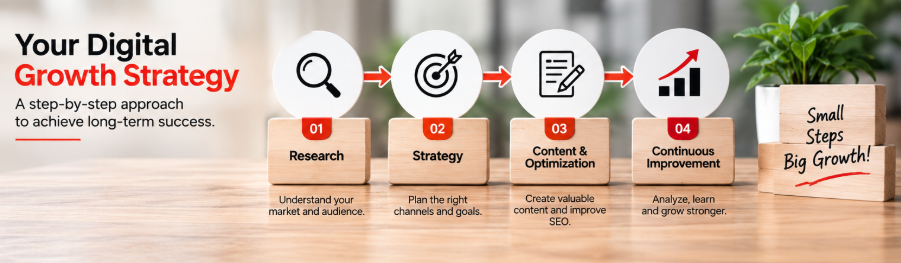
You can begin with a manageable three-month plan.
Days 1–30: Build the foundation
Define your target customer and core services.
Improve your homepage, service pages, and contact process.
Set up Google Search Console and website analytics.
Research relevant search queries.
Establish baseline performance metrics.
Days 31–60: Publish and promote
Publish useful, search-focused articles.
Improve internal links between blog posts and service pages.
Share selected insights on one or two social media channels.
Document completed projects and request genuine testimonials.
Start tracking qualified inquiries and follow-ups.
Days 61–90: Evaluate and improve
Identify pages and articles attracting relevant visitors.
Update content that is incomplete or underperforming.
Improve calls to action and inquiry forms.
Review lead quality and sales conversion.
Prioritize the channels and activities showing the strongest evidence of business value.
This plan provides structure, but results depend on your industry, competition, starting position, resources, and execution. Ninety days is a useful review period, not a guarantee of rankings or revenue.
Examples and Frequently Asked Questions
1. How can I grow my small business online without paid advertising?
Focus on organic SEO, helpful content, relevant social media activity, professional networking, referral partnerships, and a website that converts visitors into inquiries. These methods require time and consistent effort, even when advertising costs are zero.
2. Which digital marketing strategy is best for a small business?
The best strategy depends on your goals and audience. SEO and content marketing can support long-term discovery, while social media can help build relationships and distribute content. A conversion-focused website supports both. Start with the channels most relevant to your ideal customers.
3. How long does online business growth take?
There is no universal timeline. Some networking and referral activities may generate conversations relatively quickly, while organic search visibility often requires sustained effort. Review early indicators monthly and assess meaningful business outcomes over a longer period.
4. Do I need a professional website to grow online?
A professional website is strongly beneficial for most service businesses because it provides a central place to explain offers, demonstrate credibility, and receive inquiries. Your immediate priority should be a clear, functional, mobile-friendly experience rather than an unnecessarily complex design.
5. How can I tell whether my digital marketing is working?
Connect marketing activity to qualified leads, sales opportunities, conversion rates, and revenue. Use analytics to understand where visitors come from, and maintain lead records to determine which channels contribute to real business opportunities.
Conclusion: Build a Sustainable Digital Growth Strategy
Growing a small business online is not about being everywhere or following every new marketing trend. It is about understanding your customers, communicating your value, building trust, and creating a repeatable system that turns relevant attention into business opportunities.
Start with your website and core service pages. Strengthen your search visibility, publish useful content, choose appropriate social platforms, showcase genuine work, and track results. Then improve your strategy using what your customers and performance data reveal.
For businesses that need professional support, Let’s Work helps businesses strengthen their online presence through website development, digital marketing, SEO, social media management, graphic design, and other digital services.
Explore our services, review our portfolio to discuss your requirements. If you are ready to build a practical online growth plan tailored to your business, contact Let’s Work to request a customized quote.
Let’s work together!
Connect | Create | Cultivate
