
How to Choose a Digital Marketing Agency for Your Business?
Choosing the right digital marketing agency can make a significant difference to your business growth. The right partner can help you attract qualified leads, improve online visibility, strengthen your brand, and turn marketing investment into measurable business opportunities. However, with so many agencies offering similar promises, comparing expertise, services, pricing, and expected results can be challenging.
Knowing how to choose a digital marketing agency requires more than comparing proposals or selecting the lowest quote. You need a partner who understands your target audience, business objectives, competitive environment, and available budget. In this guide, we explain how to evaluate agencies, compare digital marketing agency services, understand pricing models, assess performance, and ask the right questions before signing an agreement.
How to Choose a Digital Marketing Agency: The Short Answer
Choose a digital marketing agency that understands your business goals, has relevant experience, provides a clear strategy, communicates transparently, and measures results against agreed objectives. Compare at least two or three suitable agencies, review genuine case studies, examine their proposed deliverables, and understand the full cost before committing.
The best agency is not necessarily the largest or cheapest. It is the one that offers the right combination of expertise, accountability, flexibility, and value for your business.
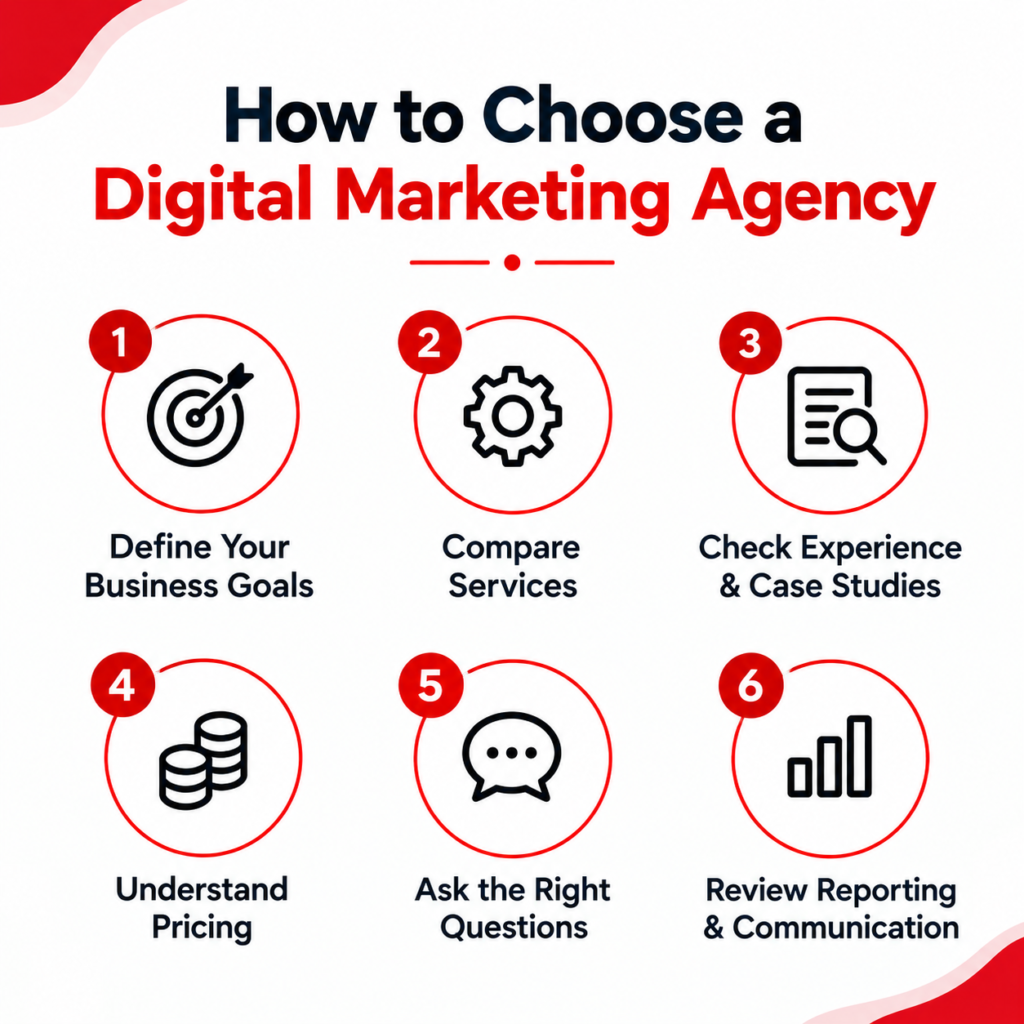
1. Define Your Business Goals Before Hiring an Agency
Before contacting agencies, identify what you want your marketing investment to achieve. Without clear objectives, it becomes difficult to evaluate proposals or determine whether an agency is delivering value. Start by identifying your biggest business challenge. For example, a new business may need a professional website and brand awareness, while an established company might want more qualified enquiries or improved conversion rates.
Your goals could include:
Increasing relevant website traffic through SEO.
Generating qualified leads through content and digital campaigns.
Improving social media engagement and brand recognition.
Developing a conversion-focused business website.
Increasing online enquiries, sales, or bookings.
Building a consistent content marketing strategy.
Turn these goals into measurable targets wherever possible. Instead of asking an agency to “improve marketing,” define an outcome such as increasing qualified enquiries, improving organic search visibility, or reducing the cost per acquired customer. Discuss your current performance, target market, competitors, and budget with potential agencies. A reliable partner should ask questions before recommending solutions.
2. Compare Digital Marketing Agency Services
Not every business needs every marketing service. Some require a specialist in search engine optimization, while others benefit from coordinated website development, content creation, and social media management.
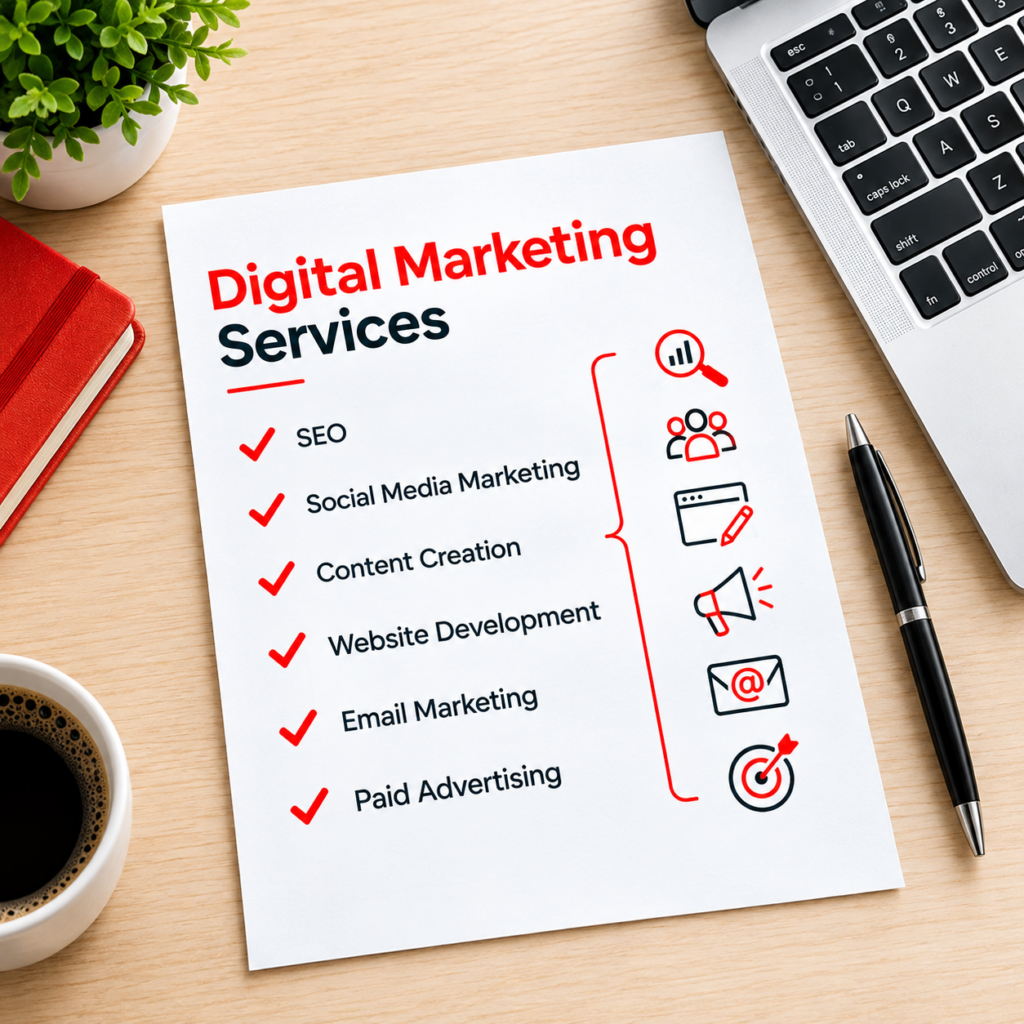
Understand the main services
Search engine optimization (SEO): Helps improve your website’s visibility for relevant searches through technical improvements, useful content, and search-focused optimization.
Social media marketing: Supports brand awareness, audience engagement, content distribution, and customer relationships across relevant platforms.
Content marketing: Uses articles, landing pages, visual content, and other resources to educate audiences and support buying decisions.
Website development: Creates or improves your website’s structure, usability, performance, and ability to convert visitors into enquiries.
Paid advertising: Uses platforms such as Google Ads and Meta Ads to reach targeted audiences, subject to campaign budgets and ongoing optimization.
Email marketing: Helps nurture prospects, communicate with existing customers, and encourage repeat business.
Should you choose a full-service agency or a specialist?
A specialist agency may be appropriate when you have a clearly defined need, such as technical SEO or paid advertising. A full-service agency may be more suitable when several marketing activities need to work together. For example, a business investing in SEO may also need optimized landing pages, informative content, and a clear enquiry process. Coordinating these activities can make it easier to maintain a consistent strategy. Ask which tasks the agency performs directly, which are outsourced, and who will manage your account. Choose based on the expertise your business actually needs rather than the number of services listed on a website.
3. Evaluate Experience, Case Studies, and Evidence
An agency’s portfolio can reveal the quality and relevance of its work, but attractive visuals and confident claims do not automatically demonstrate business results. Look for examples involving businesses; with similar audiences, objectives, industries, or marketing challenges.
When reviewing a case study, examine:
Starting point: What challenge was the client facing?
Strategy: What actions did the agency implement?
Measurement period: How long did the work take?
Results: Which metrics improved, and by how much?
Business impact: Did the improvements contribute to enquiries, sales, or another meaningful objective?
For instance, an SEO case study might report changes in search impressions, clicks, average ranking position, or qualified organic leads. Each metric tells a different story. Increased impressions indicate greater visibility, but they do not independently prove increased revenue. Request supporting reports or a discussion of the measurement process when appropriate. Ask whether the results came from organic marketing, paid campaigns, seasonal demand, or a combination of factors. Also look for clear explanations of what the agency contributed. A credible provider distinguishes observed results from outcomes it cannot confidently attribute to its work.
4. Understand Digital Marketing Agency Pricing
Digital marketing agency pricing varies according to the services required, campaign complexity, market competitiveness, deliverables, and level of support. There is no single price that fits every business.
Common pricing models include:
Monthly retainers: A recurring fee for agreed services and deliverables.
Project-based pricing: A defined fee for work such as website development or a marketing audit.
Hourly pricing: Payment for a specified amount of professional time.
Performance-based pricing: Fees linked partly to agreed outcomes, where the measurement and payment terms are clearly defined.
Before comparing quotations, check what each proposal includes. One agency might offer a lower monthly fee but provide fewer deliverables, while another includes strategy, reporting, content production, and ongoing optimization.
Ask whether advertising spend, software subscriptions, stock assets, taxes, and third-party expenses are included or charged separately.
Compare the total expected cost against the scope of work, not simply the headline price. Clarify minimum contract periods, cancellation terms, revision limits, and the process for changing deliverables.
A sensible starting point is a scope that matches your budget and business priorities. You can expand the engagement when performance, internal capacity, and business needs justify it.
5. Ask the Right Questions Before Signing
The questions to ask a marketing agency should help you understand how it thinks, works, communicates, and measures performance.
Consider asking:
How will you approach our specific business goals? Look for a tailored strategy rather than a generic package.
What will you deliver each month? Request a written list of activities, outputs, and responsibilities.
How will success be measured? Agree on relevant KPIs, reporting frequency, and conversion tracking.
Who will manage our account? Identify your main contact and the people responsible for delivery.
How often will we receive reports? Understand what reports include and how findings influence decisions.
What do you need from our team? Clarify access, approvals, content, and other dependencies.
Who owns our accounts and marketing assets? Confirm ownership and administrative access to your website, analytics, advertising accounts, and creative files.
What happens if results are below expectations? Ask how the agency diagnoses problems and adjusts its strategy.
Pay attention to the quality of the answers. A good agency should explain its recommendations in language you understand, acknowledge uncertainties, and avoid guaranteeing specific search rankings or sales figures.
6. Assess Communication, Reporting, and Marketing Tools
Marketing partnerships require regular communication and shared expectations. Before hiring an agency, establish how updates, approvals, meetings, and urgent issues will be handled.
Ask for a sample report or reporting outline. Depending on your goals, it might include:
Google Analytics 4 for website activity and tracked conversions.
Google Search Console for organic search performance.
Advertising platform reports for campaign costs and results.
A content calendar for planned marketing deliverables.
A project management system for deadlines and approvals.
Tools are useful only when the information they provide leads to informed decisions. For example, Google Analytics can help evaluate conversions attributed to different marketing channels, but accurate interpretation depends on appropriate tracking and attribution settings.
Read Google’s guidance on conversion reporting.
Agree on how often results will be reviewed and what happens when a campaign underperforms. Your agency should be able to explain what is working, what is not, and what it plans to test next.
7. Watch for Warning Signs
Before making a decision, look for potential problems that may affect the partnership. Be cautious if an agency:
Guarantees first-place Google rankings or a fixed number of sales.
Refuses to explain its strategy or deliverables.
Presents impressive statistics without context or evidence.
Uses unclear pricing, hidden fees, or restrictive contract terms.
Requests ownership of your website or advertising accounts.
Cannot explain how it measures meaningful business outcomes.
Recommends every available service without understanding your priorities.
These issues do not always prove that an agency is unsuitable, but they deserve further investigation.
Google recommends creating helpful, reliable, people-first content and following established SEO fundamentals rather than relying on manipulative shortcuts. Review the Google Search Central guidance on helpful content when evaluating an agency’s SEO approach.
8. Use a Simple Agency Comparison Checklist
Once you have shortlisted potential agencies, compare them against the same criteria.
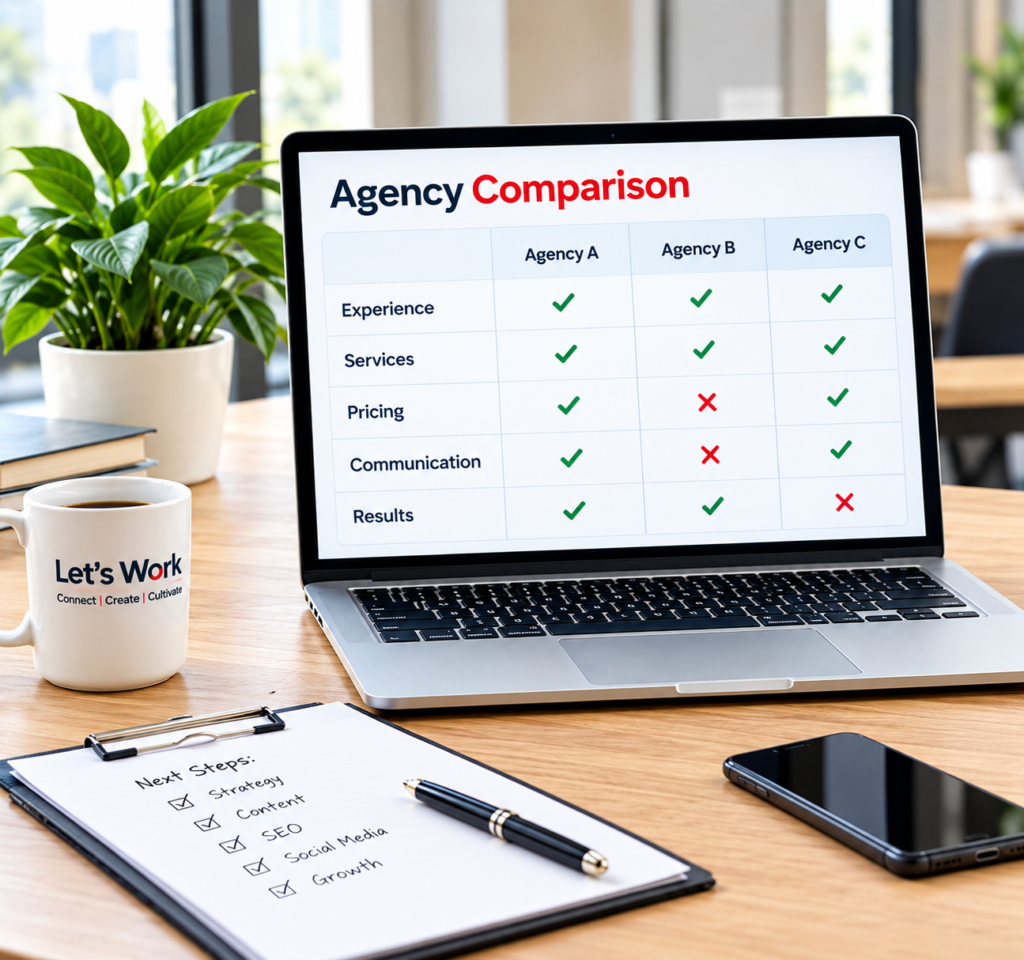
| Evaluation criterion | What to look for |
|---|---|
| Business understanding | Clear understanding of your goals and audience |
| Relevant experience | Credible projects and applicable expertise |
| Strategy | Specific recommendations and realistic priorities |
| Services | Suitable capabilities and clearly defined deliverables |
| Pricing | Transparent costs, terms, and exclusions |
| Reporting | Relevant KPIs and understandable reports |
| Communication | Clear responsibilities and regular updates |
| Ownership | Your business retains access to its accounts and assets |
| Flexibility | Scope can adapt as your needs change |
You can score each agency from 1 to 5 against these criteria. Give strategy, relevant experience, transparency, and communication greater importance if they are especially critical to your business. Do not choose solely on the highest total score. Use the comparison to identify strengths, weaknesses, and questions that still need answers.
Frequently Asked Questions
1. How much does a digital marketing agency cost?
Costs depend on the services, scope, market, and level of expertise required. Ask for a written proposal outlining deliverables, recurring fees, additional expenses, and contract terms before comparing offers.
2. How long does it take to see digital marketing results?
Timelines vary by channel and starting conditions. Paid campaigns may generate early activity, while SEO and content marketing often require sustained work. Ask the agency to establish realistic milestones rather than promise a universal timeline.
3. Should a small business hire a digital marketing agency?
Yes, if external expertise can address a genuine skills or capacity gap and the investment fits the business budget. A small business can start with one or two priority services instead of purchasing a comprehensive package.
4. What is the difference between an SEO agency and a digital marketing agency?
An SEO agency primarily focuses on organic search visibility. A digital marketing agency may also provide website development, social media marketing, content creation, email marketing, and paid advertising. Some agencies specialize in both SEO and broader digital strategy.
5. How can I measure whether an agency is worth the investment?
Track agreed KPIs such as qualified leads, conversion rates, customer acquisition costs, relevant organic traffic, and revenue where reliable attribution is possible. Compare results with your starting point and business objectives, accounting for costs and other factors that influence performance.
Conclusion: Choose a Marketing Partner That Understands Your Business
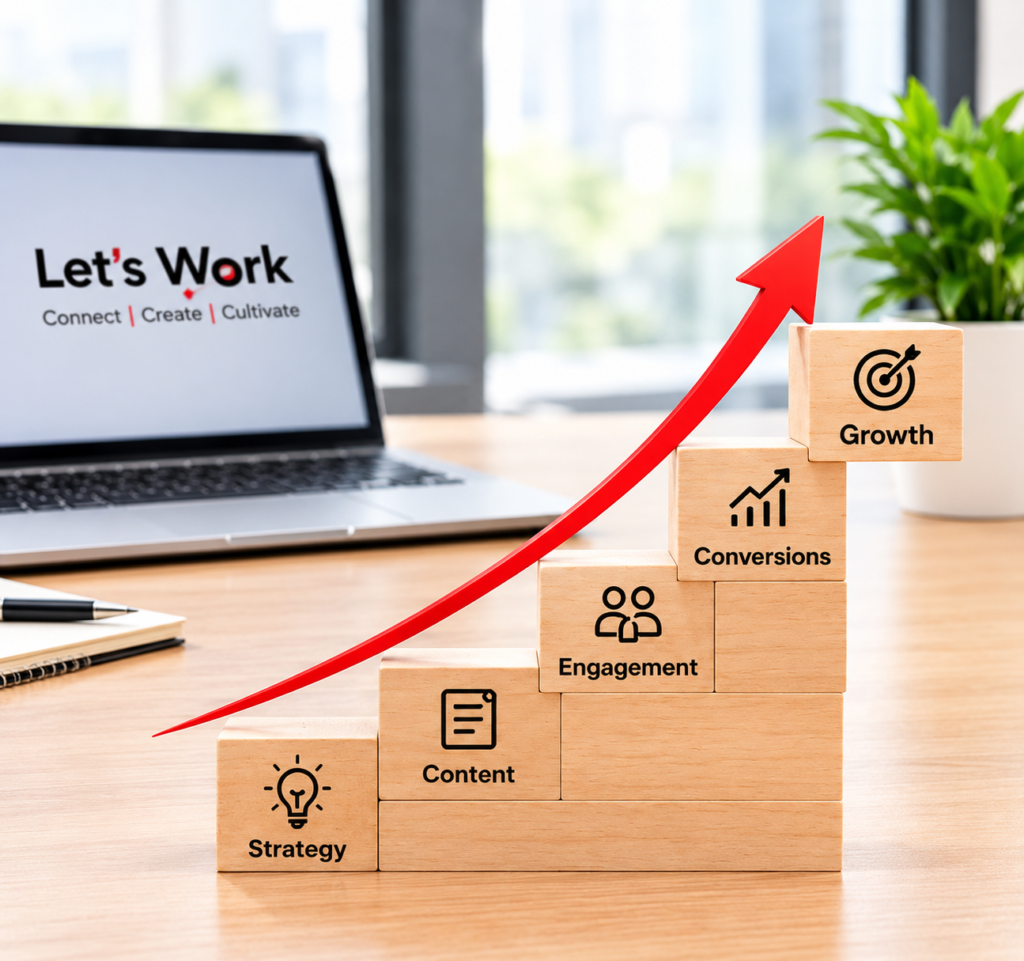
Learning how to choose a digital marketing agency is ultimately about finding a partner whose strategy, capabilities, communication, and pricing align with your business goals.
Before committing, define your objectives, compare relevant experience, evaluate the proposed services, review the complete costs, and agree on measurable performance indicators. Make sure you retain appropriate ownership and access to your digital assets, and choose an agency that explains its decisions clearly.
At Let’s Work, we help businesses strengthen their digital presence through website development, SEO, social media marketing, content creation, and other digital marketing services. Our approach focuses on understanding your requirements and identifying practical solutions suited to your objectives.
Explore our Digital Marketing Services or Website Development Services to learn more about how we can support your business.
Ready to discuss your requirements? Visit Let’s Work and request a customized quote for your business.
Connect | Create | Cultivate.
