
Digital Marketing for Small Businesses: Which Strategies Actually Work?
Introduction
Running a small business means balancing customer service, daily operations, sales, and growth. With limited time and marketing budgets, choosing the right promotional channels can feel overwhelming. Posting regularly on social media or running advertisements may generate attention, but attention alone does not guarantee enquiries or sales.
Digital marketing for small businesses works best when every activity supports a clear business objective. Whether you want to attract local customers, generate website enquiries, increase online sales, or build brand awareness, the right combination of search engine optimization (SEO), social media, content marketing, paid advertising, and email communication can help.
In this guide, we explain which small business marketing strategies are worth prioritizing, how to measure their effectiveness, and when professional online marketing services can help you achieve your goals.
Which Digital Marketing Strategies Actually Work?
The most effective digital marketing strategies connect the right audience with a relevant offer through the appropriate channel. SEO helps customers discover your business through search engines, social media builds awareness and relationships, content marketing answers customer questions, and paid advertising can generate targeted traffic. Email marketing supports customer retention, while a well-designed website converts interest into enquiries or sales. Rather than investing in every channel at once, start with your audience, business objectives, available budget, and measurable outcomes. Test a small number of strategies, track the results, and increase investment in the activities that demonstrate value.
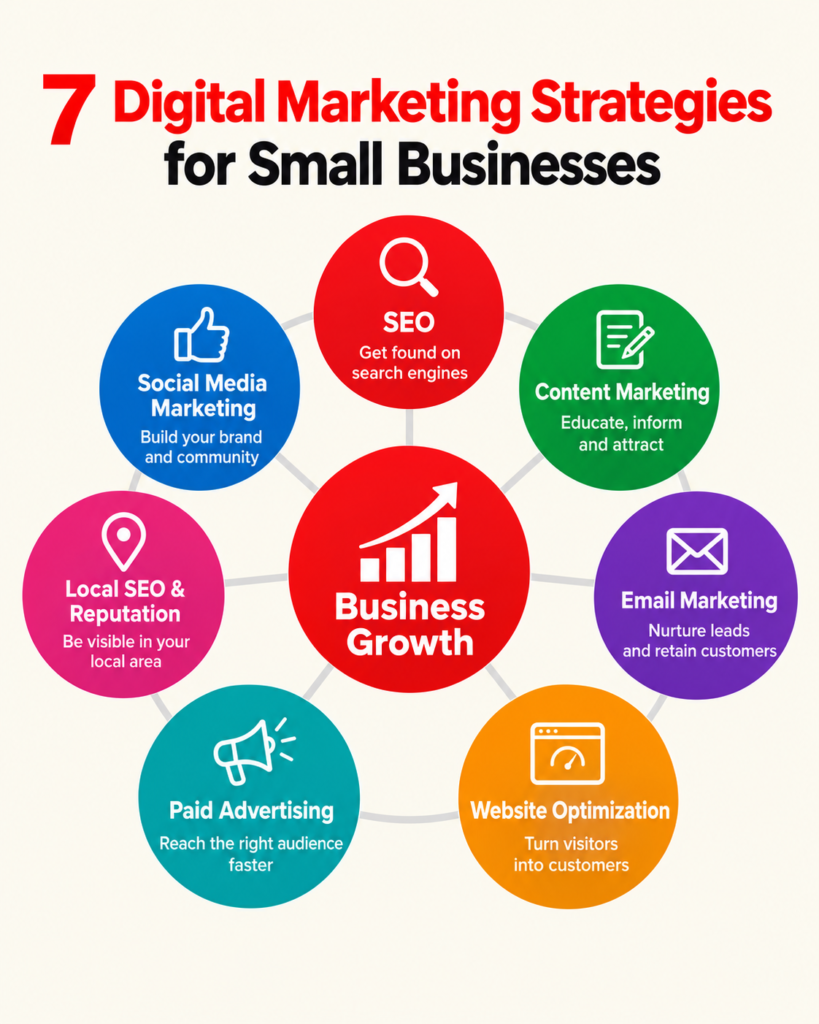
7 Digital Marketing Strategies for Small Businesses
1. Search Engine Optimization (SEO)
SEO helps your website appear in relevant organic search results when potential customers look for your products or services. Unlike paid advertising, organic search visibility does not require paying for every click, although SEO requires time, expertise, and ongoing effort. For example, a local accounting firm could create a service page targeting “small business accountant in Lahore” or its actual service area. A web design company could publish a useful guide explaining website development costs for small businesses.
How to get started:
-
Research the phrases your potential customers use when searching online.
-
Create dedicated pages for your main services.
-
Write useful articles that answer common customer questions.
-
Improve page titles, headings, internal links, and image descriptions.
-
Use Google Search Console to monitor search impressions, clicks, and queries.
Local businesses should also maintain an accurate Google Business Profile, add relevant photos, and respond to customer reviews. Google identifies relevance, distance, and prominence as key factors in local rankings. SEO is particularly valuable for businesses seeking sustainable visibility and customers who are already looking for their services. However, results are not immediate, and no agency can guarantee a particular ranking.
2. Social Media Marketing
Social media marketing allows businesses to showcase their products, explain their services, answer questions, and develop relationships with prospective customers. The best platform depends on your audience and business model. Instagram and Facebook can be useful for visually engaging consumer businesses, while LinkedIn may be more appropriate for professional services and business-to-business companies. TikTok and YouTube can help businesses demonstrate products, share tutorials, and publish short-form or long-form videos.
A practical approach:
Choose one or two platforms your target customers actively use.
Develop a weekly content calendar.
Mix educational posts, demonstrations, customer questions, and promotional content.
Respond promptly to comments and direct messages.
Track meaningful engagement, website visits, enquiries, and conversions.
For example, a home renovation company could publish project walkthroughs, explain material choices, and share maintenance advice. These posts demonstrate expertise rather than repeatedly asking followers to purchase. Consistency matters, but publishing more content is not automatically better. Focus on content quality, audience relevance, and measurable business outcomes.
3. Content Marketing
Content marketing attracts potential customers by providing information that helps them understand a problem, compare options, or make a purchasing decision. Useful formats include blog articles, frequently asked questions, case studies, infographics, videos, and downloadable guides. Suppose you operate a small accounting business. An article explaining common bookkeeping mistakes could attract business owners researching financial management. Relevant internal links could then guide readers toward your bookkeeping services page.
Effective content should:
Address a specific customer problem.
Provide clear, practical answers.
Include examples and credible references where appropriate.
Link to relevant services and related articles.
End with a useful next step.
Content marketing also supports search visibility and AI-powered search experiences when it provides accurate, original, well-organized information. Google’s guidance emphasizes helpful, reliable, people-first content rather than writing solely to manipulate rankings.
4. Pay-Per-Click Advertising
Paid advertising through platforms such as Google Ads and Meta Ads can help businesses reach targeted audiences and test offers more quickly than organic strategies alone. Google Search Ads can reach people actively searching for particular services. Meta Ads can help businesses introduce products, reach selected audiences, and reconnect with eligible previous website visitors. Before launching a campaign, define the conversion you want: a qualified enquiry, appointment booking, purchase, or phone call.
For better results:
Set a realistic daily or monthly budget.
Target relevant locations and customer segments.
Use focused ad copy and clear calls to action.
Direct users to a relevant landing page.
Configure conversion tracking before evaluating performance.
Monitor cost per lead, conversion rate, lead quality, and revenue where measurable. A campaign that generates many inexpensive clicks but few qualified enquiries may be less valuable than one attracting fewer, more relevant visitors. Paid advertising can generate traffic quickly, but it does not guarantee profitable sales. Results depend on competition, targeting, offer quality, landing pages, and follow-up.
5. Email Marketing
Email marketing helps businesses maintain relationships with people who have willingly subscribed or otherwise provided appropriate permission to receive communications. It can support lead nurturing, product announcements, appointment reminders, repeat purchases, and customer retention. Start by building a permission-based subscriber list. Offer something useful, such as a practical guide, newsletter, or relevant business update. Segment subscribers according to their interests where appropriate, and send messages that provide genuine value.
Tools such as Mailchimp and HubSpot can help manage email campaigns, automate selected communications, and track engagement. For example, a small consultancy could send a monthly newsletter featuring practical advice, recent service updates, and an invitation to arrange a consultation. Measure click-through rates, enquiries, conversions, unsubscribes, and revenue attributable to campaigns. Follow applicable privacy and anti-spam requirements, and avoid purchasing email lists.
6. Website Optimization and Conversion Rate Improvement
Your website should make it easy for visitors to understand your services, assess your credibility, and take the next step. Even effective SEO or advertising can underperform if visitors encounter slow pages, confusing navigation, unclear pricing information, or difficult enquiry forms.
Review your website for:
Clear service descriptions and customer benefits.
Mobile-friendly layouts and readable content.
Fast-loading pages and functional navigation.
Relevant testimonials or verified case studies.
Visible contact details and calls to action.
Simple forms that request only necessary information.
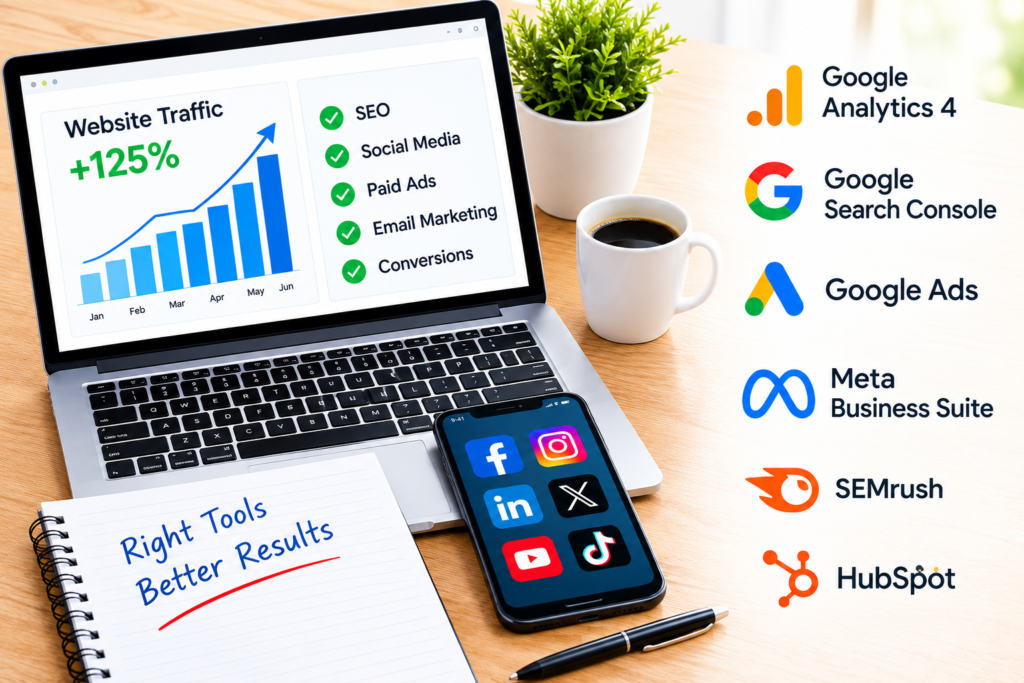
Google Analytics 4 can help you understand website engagement and configured conversions, while Google Search Console provides search performance data. Page Speed Insights can help identify performance issues. For instance, a service business receiving website visits but few enquiries could test a clearer headline, a more relevant landing page, or a shorter contact form before increasing its advertising budget.
7. Online Reputation and Local Marketing
Customer reviews, accurate business information, and a consistent online presence help prospective customers evaluate your business. For companies serving a particular city or region, local SEO can be especially useful. Keep your business details accurate, choose relevant categories, publish genuine photos, and respond professionally to reviews. Encourage customers to share honest feedback without offering prohibited incentives or manufacturing reviews. Use feedback to identify recurring concerns and improve your service.
You can also develop relationships with complementary businesses, participate in relevant community activities, and create locally useful content. For example, a local fitness studio might publish practical information about beginner classes, facilities, schedules, and its service area. This gives potential customers information they need before making contact.
How to Choose the Right Small Business Marketing Strategies?
Not every business needs every channel. Use your immediate objective to guide your investment.
| Business objective | Strategies to prioritize | Useful measurements |
|---|---|---|
| Improve organic visibility | SEO and content marketing | Search clicks, relevant rankings, organic enquiries |
| Generate immediate enquiries | Paid search advertising and landing pages | Qualified leads, cost per lead |
| Build brand awareness | Social media and video content | Relevant reach, engagement, branded searches |
| Increase repeat business | Email marketing and customer follow-up | Repeat purchases, conversions |
| Attract nearby customers | Local SEO and reputation management | Calls, direction requests, local enquiries |
| Improve website sales | Website optimization and conversion testing | Conversion rate, revenue, abandonment |
Start with a clear marketing plan. Identify your target audience, competitive advantage, budget, sales objectives, and the activities you can realistically maintain. Review performance regularly and adjust your priorities based on evidence rather than assumptions.
Examples: What Could Work for Different Small Businesses?
Local service provider: A plumber could optimize local service pages, maintain a Google Business Profile, and run targeted search ads for high-intent enquiries.
Online retailer: A clothing store could combine product-focused social content, relevant search optimization, email campaigns, and carefully measured retargeting where permitted.
B2B consultancy: A business consultant could publish practical industry articles, use LinkedIn to distribute insights, and offer a consultation through a focused landing page.
These are illustrative strategies, not verified client case studies or guaranteed outcomes. Each business should test its approach using actual performance data.
Frequently Asked Questions
1. What is the best digital marketing strategy for a small business?
It depends on your goals, audience, and competition. Local service businesses may benefit from local SEO and targeted search ads, while consultancies may prioritize useful content and LinkedIn. Begin with the channel most closely connected to your customers’ buying journey.
2. How much should a small business spend on digital marketing?
There is no universal budget. Consider your available resources, customer acquisition costs, profit margins, competition, and growth targets. Separate service fees from advertising expenditure, and begin with a manageable test budget before scaling successful campaigns.
3. How long does digital marketing take to produce results?
Paid campaigns can generate traffic soon after launch, although profitable conversions may take longer to establish. SEO often requires several months to demonstrate meaningful progress, depending on competition, website condition, and implementation. Review performance consistently rather than expecting guaranteed timelines.
4. Should I hire a digital marketing agency or manage marketing myself?
Managing marketing internally may suit businesses with the necessary skills and time. A professional agency or service provider can offer specialist expertise, consistent execution, and coordinated campaigns. Compare the expected deliverables, communication, reporting, costs, and business objectives before deciding.
5. How do I know whether my marketing is working?
Track outcomes that matter to your business, including qualified enquiries, purchases, conversion rates, cost per lead, and customer acquisition costs. Use Google Analytics 4, Google Search Console, advertising dashboards, and CRM records where appropriate. Measure lead quality and revenue, not just impressions or likes.
Conclusion: Build a Digital Marketing Strategy That Supports Growth
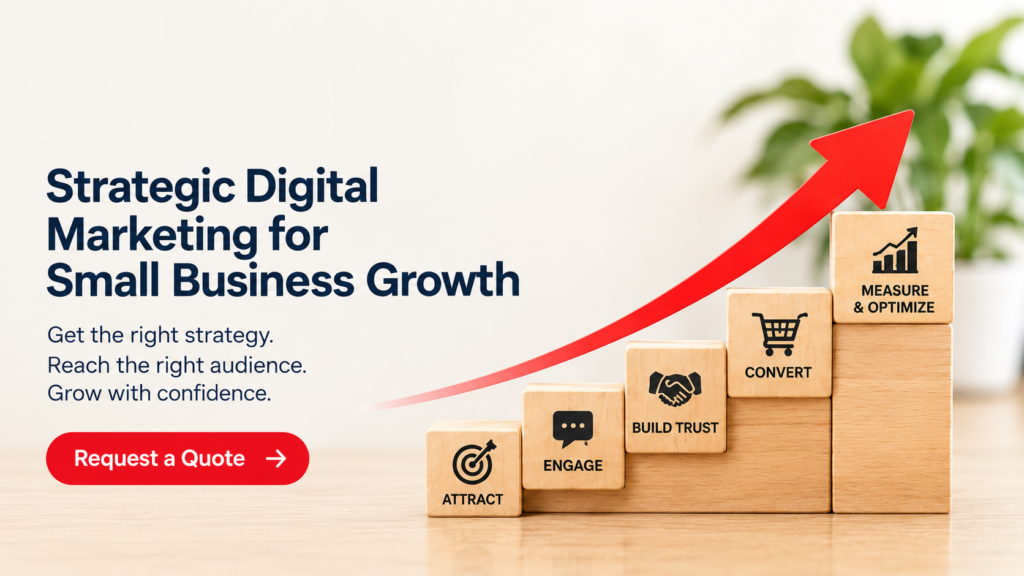
Successful digital marketing for small businesses is not about being everywhere online. It is about understanding your customers, selecting appropriate channels, communicating a clear value proposition, and measuring whether your activities contribute to meaningful business results. Start with the essentials: a useful website, a focused SEO strategy, consistent and relevant content, and a reliable way to capture and follow up on enquiries. Introduce paid advertising, email automation, or additional social platforms when your objectives and resources justify them.
If you need help coordinating these activities, Let’s Work can support your business with digital marketing, SEO, social media management, content production, and website development.
Visit letswork.id to explore our services and view our portfolio. Tell us about your business, target audience, and marketing goals to discuss a suitable approach and request a quote.
Let’s work together to attract the right audience, build trust, and turn more opportunities into customers.
Let’s work together!
Connect | Create | Cultivate
